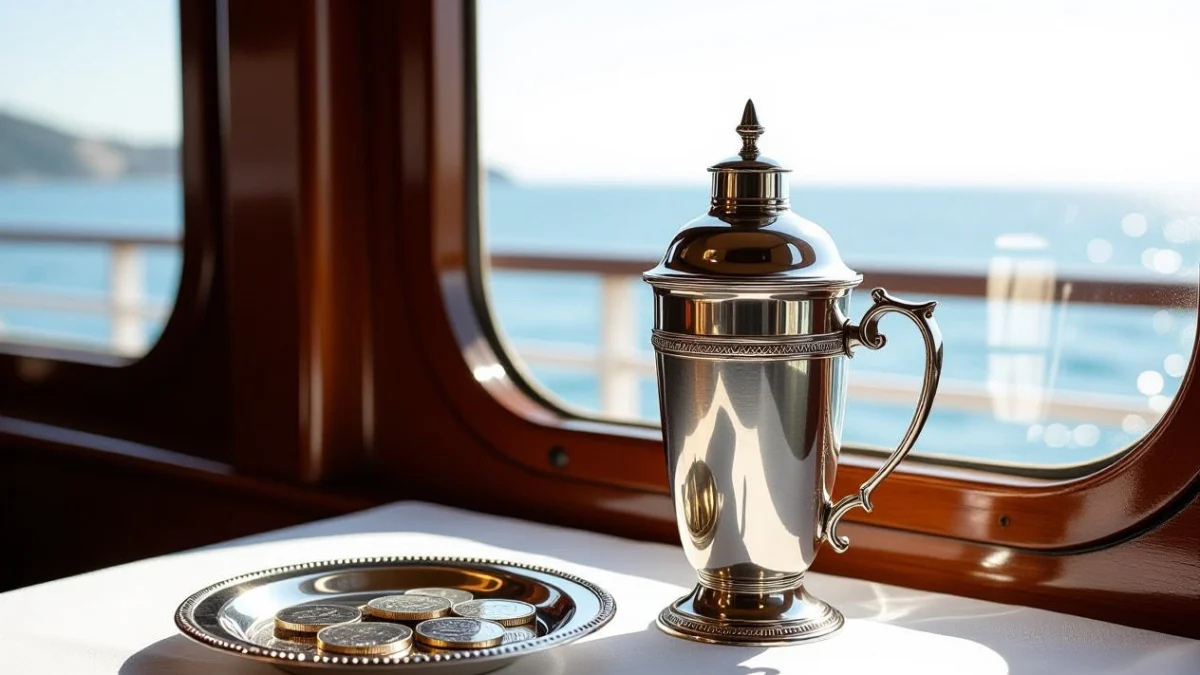
The cocktail shakers made for transatlantic liners in the 1930s are often overlooked by collectors looking for Art Deco pieces. The pieces combine streamlined geometry and sterling silver craftsmanship to create objects that are still appealing today.
Ocean Liners in the Golden Age of Silver
In the short but brilliant period between the Wall Street Crash and World War II’s outbreak, shipping lines such as French Line, Cunard-White Star and Holland-America Line hired renowned silversmiths for the decoration of their first-class rooms. Cocktail shakers were created with stepped shapes, fluted tops and engine-turned panels, which mirrored ship architecture. The era was marked by fierce competition among the great passenger companies, each striving to outdo the others with ever more luxurious appointments. First-class passengers expected to be surrounded by the finest materials, and silverware became a visible demonstration of a line’s prestige. Silversmiths such as Elkington & Co., Mappin & Webb and the French master Jean Puiforcat were commissioned to produce entire suites of barware that would complement the sweeping curves of the dining salons and the geometric inlays of the smoking rooms. These objects were not merely functional; they embodied the spirit of speed and modernity that the liners themselves represented.
The design vocabulary of the period was unmistakable. Stepped silhouettes echoed the tiered decks of the ships, while engine-turned panels imitated the riveted hull plating visible from the promenade. Fluted tops suggested the funnels that crowned each vessel, and the polished surfaces caught the light in the same way that the sea reflected sunlight during an Atlantic crossing. Because the shakers were intended for use at sea, practical considerations also shaped their form. Weighted bases kept them stable when the ship rolled, and cork-lined lids created a tight seal that prevented precious liquor from spilling. Many examples carry the subtle crest of the shipping line on the front and the silversmith’s mark on the base, providing collectors with clear provenance.
The Period Design Element
Genuine examples have sharp, machine-finished edges that contrast beautifully with the hand-raised bodies. Some still have the original weighted base and cork-lined tops that were designed to stay steady in a swell. Due to the fact that the sets were made in small batches, they carry the ship’s subtle crest and maker’s marks. The combination of machine precision and hand finishing is one of the most appealing aspects of these pieces. The edges were milled to a knife-like sharpness, while the bodies were raised over wooden forms by skilled craftsmen who spent weeks coaxing each curve into existence. The result is a surface that feels cool and precise to the touch yet retains the subtle irregularities that betray its handmade origin. Collectors prize this tension between industrial exactitude and artisanal warmth.
The small-batch nature of production also means that surviving examples are rare. Unlike the mass-produced hotel silver that filled land-based establishments, liner silver was made in quantities measured in dozens rather than hundreds. Each piece was numbered and logged in the ship’s inventory, allowing historians to trace individual shakers to specific voyages. When wartime metal drives swept through Europe and North America, many of these carefully documented objects were melted down for the war effort. The few that escaped now stand as tangible reminders of a vanished age of luxury travel.
Why these Shakers are Important to Collectors
Liner pieces, unlike hotel silver or railroad sterling, traveled around the world and endured multiple refurbishments. The scarcity of these pieces is due to the wartime metal drives which melted many of them down, leaving a small fraction. Silver investors and design history enthusiasts have driven the prices of documented pieces to a steady rise. Because each shaker crossed the Atlantic dozens of times, it accumulated a patina that cannot be replicated in a museum setting. The tiny scratches on the base tell the story of countless cocktail hours in the company of film stars, industrialists and exiled royalty. This narrative quality adds an intangible value that purely decorative objects lack.
Market data from the past decade shows a consistent upward trajectory for authenticated liner silver. A 1935 French Line cocktail set that sold for £2,800 in 2014 fetched £7,400 at auction in 2023. The increase reflects both growing recognition of the pieces’ historical importance and the diminishing supply of documented examples. Museums have begun to acquire representative pieces for their permanent collections, further tightening availability on the private market. For serious collectors, the presence of a ship’s inventory number, a matching period case, or original documentation dramatically increases desirability and price.
Preserving Your Property Without Damage
Store silver in low humidity environments to prevent tarnish. Use non-abrasive polishing cloths for a gentle shine that maintains its original turning. Instead of using commercial dips, which can remove fine details, use a mild solution with soap and dry the item thoroughly. Additional care should include rotating stored pieces every few months to prevent “silver creep,” the slow migration of metal that can distort weighted bases over decades. Avoid stacking shakers directly on one another; instead, wrap each piece in acid-free tissue and place it in a separate compartment of a wooden canteen. If the cork lining has deteriorated, replace it with new natural cork rather than synthetic materials that may off-gas and accelerate tarnish. When displaying pieces, keep them away from direct sunlight and strong artificial light, both of which can cause uneven fading of any remaining gilt highlights.
General Recommendations
Visit the Victoria and Albert Museum’s Silver Collection Pages, the Mariners’ Museum Research Portal, and the Silver Society of the United Kingdom’s annual schedule for more information. In addition, the archives of the Compagnie Générale Transatlantique in Le Havre and the Cunard Line records at the University of Liverpool offer primary source material for researchers seeking to authenticate specific pieces. Auction houses such as Christie’s and Sotheby’s periodically publish catalogues raisonnés that list every known liner silver maker’s mark, providing an invaluable reference for attribution. Local silver societies often host handling sessions where members can examine comparable objects under museum conditions, an opportunity that sharpens the eye for the subtle differences between genuine and reproduction pieces. Online forums dedicated to ocean-liner memorabilia also serve as clearing houses for newly discovered examples, although buyers are advised to insist on independent metallurgical testing before committing significant funds. By combining archival research, careful provenance study and meticulous conservation, collectors can ensure that these elegant artifacts of the golden age of steam continue to be appreciated for generations to come.